Skip to the filmSkip to the application

PercepticOS. Your R&D teams and AI,
reasoning as one.

Your teams and AI work the same question in one shared study. AI does the evidence work, your experts make the calls, and every decision stays traceable, secure and yours.

Zaki Trache, Co-Founder and CPO, at the close of the PercepticOS launch film.

Introducing PercepticOS

Film · 3:57

Introducing PercepticOS, from

Introducing PercepticOS: the world’s first AI Operating System for Scientific Discovery, where your R&D teams and AI reason through a decision together.

Everything your R&D organization knows, in one place: its data, and its experts across functions and the ideas they build over the years. Every decision is kept with the reasoning behind it, so what one team learns, the whole organization remembers.

Rigorous. Break the hypothesis down. Build the evidence up. Each claim is tested against its sources, and your experts check the evidence and make the call. AI does the evidence work; it never has the final word.

Flexible. PercepticOS works with what your teams already use, plugging into your existing tools and infrastructure. Use the most efficient model for each task and switch whenever you like, with no vendor lock-in.

Secure. Your data is never used to train models. You decide who sees each study and dataset, in line with your own policies, with tight access controls and governance built in.

“I’ve seen promising drug programs fail for reasons that had nothing to do with biology. Great science alone does not make a medicine.”

Dr. Tilman FlockCo-Founder and CEOWatch from 0:28

Apply for accessSkip the walkthrough

Skip the walkthrough

The argument

Reasoning you can see and shape.

PercepticOS is built for complex, cross-functional R&D decisions that draw on multimodal evidence. It lays the decision out as an argument your team can see and challenge, with sections, claims specific enough to test, and links that show what each claim depends on.

An illustrative study. Its claims are open research questions.

  1. Ask

    Start with the decision.

    Describe the decision you need to make and point it to the sources that matter, public or internal. Then pick the model and how deep the reasoning goes.

    A question typed into the composer, with a file attached.

  2. Sections

    Structured the way your teams already work.

    The decision breaks into sections that mirror how your organization works, here biology, clinical evidence and translation.

    The question divided into three sections, each showing how many claims it holds.

  3. Claims

    Build the argument from testable claims.

    Each claim is a statement that evidence can support or refute. It only changes state once one of your experts has validated the evidence.

    One section opened into its claims, each marked with its state.

  4. Links

    Strengthen the argument with every link.

    Links show how your claims depend on one another, and each link is tested in its own right. With supporting and disconfirming evidence side by side, your team reaches conclusions that stand up to challenge.

    Labeled links between the claims, one of them flagged by its check.

Skip to the next section

Autonomy

Let agents do the groundwork
while your team steers.

Send agents out on a single claim or a whole section. They search the literature, open the data and run the analyses in parallel, for as long as the work needs, while your team guides them.

A study map with three sections. Agents run on six research claims at once; one run stops to ask the team a question, and the answer goes onto its claim as a signed decision.

An illustrative study. Its claims are open research questions.

  1. Working

    Reasoning from both directions.

    Each claim gets its own run. Agents reason deductively from the hypothesis and inductively from the data, and you can follow the work and step in at any point.

    Six research claims, each with a run in progress, and the study's status line counting them.

  2. Needs you

    It knows when to bring in an expert.

    When the evidence is uncertain or conflicting, the agent stops and puts the question to the right person on your team, with the options laid out and what each one would change.

    One claim’s run has stopped with a question for the team, marked in gold.

Skip to the next step

Provenance

Traceable to the line.

Every finding links back to its source, down to a single figure in a paper or a data point from your own experiments. Your experts can open any of it, see what each source does and does not show, and weigh the trade-offs before anything enters the argument.

One claim, opened level by level: the claim, its evidence, the passage quoted from the first source, and the paper.

  1. Claim

    The claim, marked with its current state. Genetically lower IL-6 signaling blunts the cardiovascular risk that comes with CHIP. (Investigating)

  2. Evidence

    The claim’s evidence: each source with its stance and strength. Corroborating, Moderate: Bick et al., Circulation, 2020. Corroborating, Moderate: Vlasschaert et al., Circulation, 2023. In tension, Moderate: Kessler et al., Nature, 2022. Stance and strength: Evidence in tension stays on the record.

  3. Passage

    The quoted passage from the source, with its location and limits. “IL6R p.Asp358Ala attenuated CVD event risk among participants with large CHIP clones” (Abstract: Results). Does not show: Lifelong germline variation, not a late-life drug; per allele, in large DNMT3A or TET2 clones, without prevalent CVD. All three include UK Biobank exomes; Bick 2020 and Vlasschaert 2023 share authors. Vlasschaert ties the split to CHIP calling. Bick's outside cohort had few large-clone carriers. Recorded by the agent: Scope travels with the evidence.

  4. Source

    The full citation, with a link to the paper on PubMed.

    Bick et al. Genetic Interleukin 6 Signaling Deficiency Attenuates Cardiovascular Risk in Clonal Hematopoiesis. Circulation. 2020.

    PMID
    31707836
    DOI
    10.1161/CIRCULATIONAHA.119.044362
    Read the paper on PubMed

An illustrative study. Its claims are open research questions.

Record

A record that grows with every study.

Every change is logged with who made it and why. Study by study, that record becomes your organization’s memory.

The study's statement of where it stands, with an update drafted by an agent waiting to be applied.

Evidence overview

The whole study,
at a glance.

Evaluate the whole argument in one view, from the scientific case to the commercial one. Branch the study to explore what-if scenarios and related hypotheses.

Should IL-6 or IL-6-receptor blockade be tested to prevent cardiovascular events in people with clonal hematopoiesis, and in whom?

As of October 2026 we found no registered IL-6 or IL-6-receptor blockade trial in CHIP-selected people. The genetic signal is reported in large clones, mostly from one biobank, so we measure first. (Marcus, study lead)

  1. Biology

    In mice, Tet2 loss speeds atherosclerosis, with a role for NLRP3 and IL-1β (Science 2017). That IL-6 carries the risk in people rests so far on genetics (Circulation 2020). (Tomás, vascular biologist)

    1. CHIP raises cardiovascular risk through inflammation that IL-6 signaling carries. (Investigating)
    2. CHIP is associated with a higher risk of coronary heart disease in humans. (Supported)
    3. Loss of Tet2 in blood cells accelerates atherosclerosis in mice. (Supported)
  2. Clinical evidence

    As of October 2026 we found no IL-6 or IL-6-receptor blockade trial in CHIP-selected people. If we design one, it enrols large clones (allele fraction >10%). (Ines, clinical lead)

    1. Inhibiting IL-6 signaling lowers cardiovascular events in people with CHIP. (Open)
    2. Genetically lower IL-6 signaling blunts the cardiovascular risk that comes with CHIP. (Investigating)
    3. The IL6R genetic effect is concentrated in carriers of large clones. (Investigating)
    4. TET2 CHIP carriers gain more cardiovascular benefit from IL-1β inhibition than non-carriers. (Inconclusive)
    5. IL-6 ligand inhibition lowers major cardiovascular events in an inflamed population not selected for CHIP. (Open)
    6. The safety profile of IL-6 or IL-6-receptor blockade is acceptable in carriers who have no symptoms. (Open)
  3. Translation

    We will not screen anyone without a hematology pathway in place; a risk score already separates the high-risk minority of people with CHIP or CCUS (NEJM Evid 2023). (Hana, trial design)

    1. A CHIP-defined trial population can be found, justified and enrolled. (Investigating)
    2. Restricting enrolment to large clones raises the risk per carrier but shrinks the eligible pool. (Investigating)
    3. Screening adults for CHIP identifies a minority whose myeloid-cancer risk needs hematology follow-up. (Investigating)
  1. does blocking it change outcomes? Inhibiting IL-6 signaling lowers cardiovascular events in people with CHIP. (Open)
  2. does clone size matter? The IL6R genetic effect is concentrated in carriers of large clones. (Investigating)
  3. Large clones only (allele fraction >10%) (Priya, cardiologist)
  4. Measure IL-6 signaling and clone size over time in large-clone carriers before designing an outcomes trial. The human case is genetic and mostly from one biobank; a direct measurement in carriers is the smallest step that could change the decision.
Skip to the evaluation

Platform

Computing power, built in.

Every run gets its own isolated sandbox, with Python and R, your packages, models and internal tools, and the compute each analysis needs, GPUs included. Long-running jobs carry on unattended.

Built-in plugins, plus your own.

PercepticOS ships with plugins for the literature, public databases and specialist tools. Add your internal systems to the same versioned catalog, and set them per workspace, study or run.

Runs wherever your data lives.

Deploy in your own cloud, or let us run a dedicated environment for you. Either way, each task runs on the most efficient model for the job, from any provider, with no lock-in.

Models
Swap models without rebuilding.
Plugins
Set per workspace, study or run.
PercepticOS
Studies, agents and the full record.
Infrastructure
Your cloud, or a dedicated one.

Evaluation

Ahead of the model it runs on.

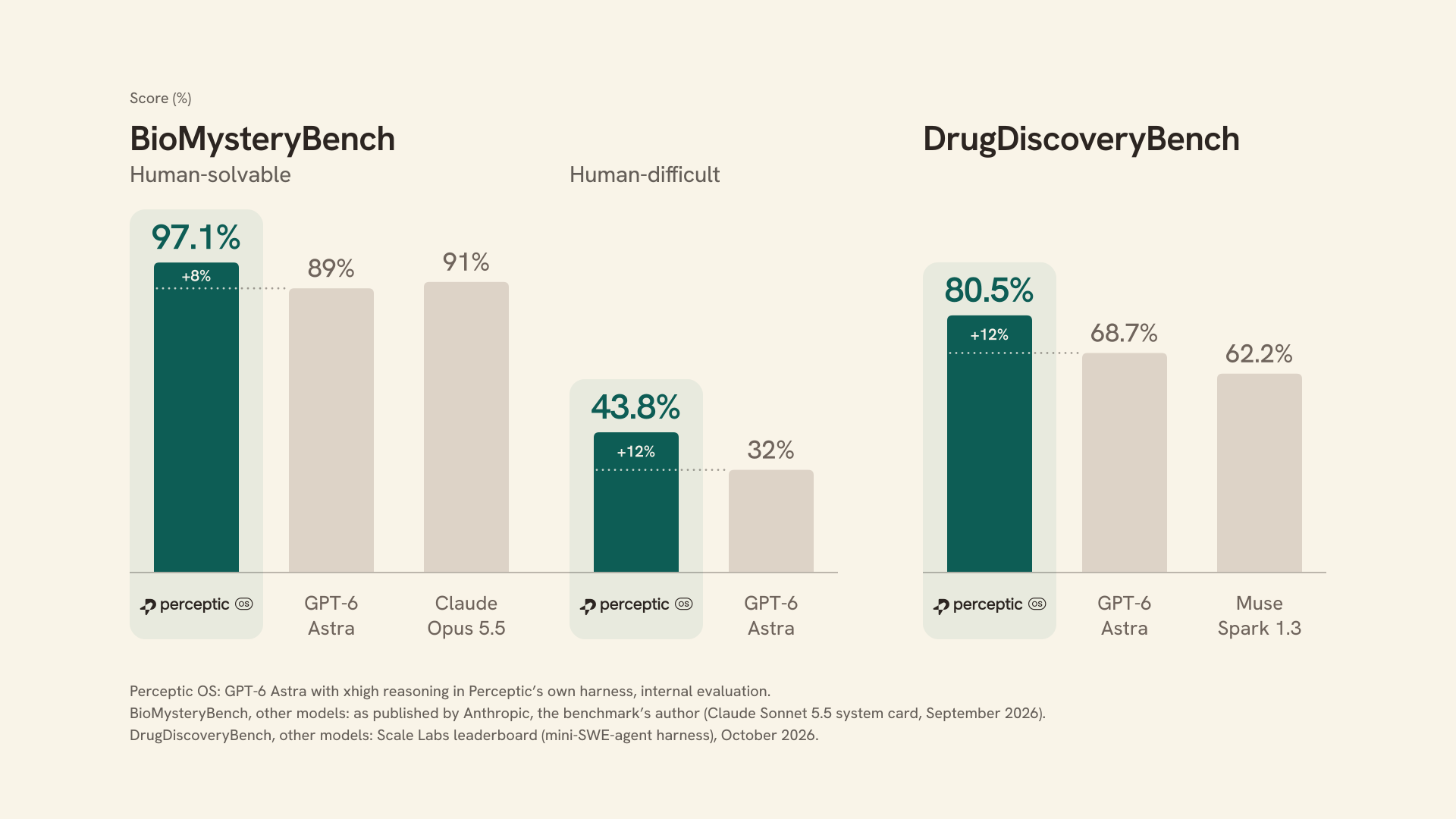
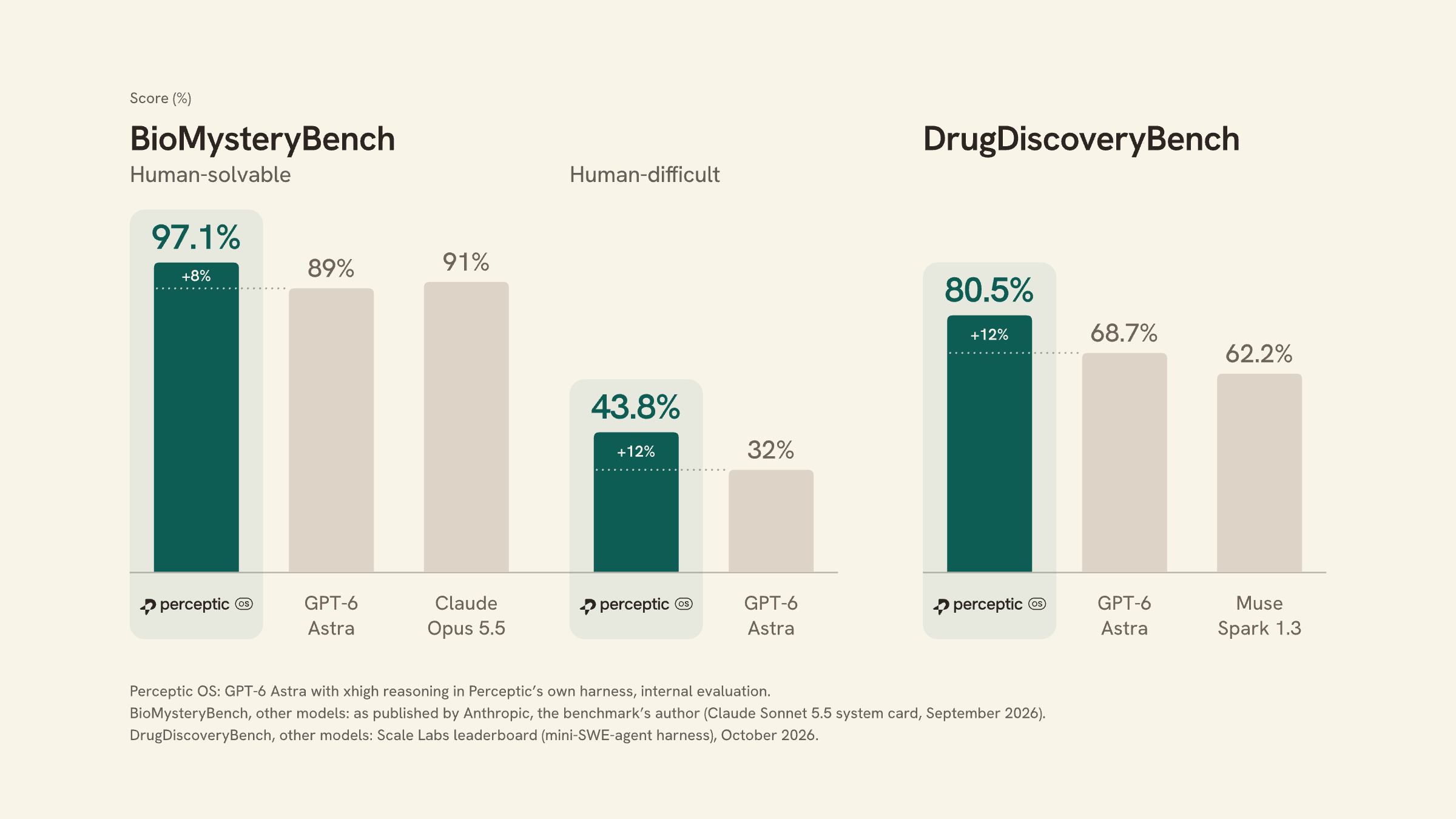
The model is only the starting point. On BioMysteryBench and DrugDiscoveryBench, PercepticOS running on GPT-6 Astra beat that model’s own published scores in every group we tested, by up to 12 points. 1 The structure that makes the reasoning traceable also makes it stronger.

View as table
Benchmark results Score (%)
PercepticOS 1GPT-6 AstraClaude Opus 5.5Muse Spark 1.3
BioMysteryBench 2Human-solvable97.1%89%91%Not shown
BioMysteryBench 2Human-difficult43.8%32%Not shownNot shown
DrugDiscoveryBench 380.5%68.7%Not shown62.2%
  1. Perceptic OS: GPT-6 Astra with xhigh reasoning in Perceptic’s own harness, internal evaluation.
  2. BioMysteryBench, other models: as published by Anthropic, the benchmark’s author (Claude Sonnet 5.5 system card, September 2026).
  3. DrugDiscoveryBench, other models: Scale Labs leaderboard (mini-SWE-agent harness), October 2026.

Download the chartSVGPNG

Governance

Governance your security team can sign off.

Access
Single sign-on, with every study private until its owner shares it.
Data
Your data never trains a model.
Models
Admins decide which models are approved for use.
Approvals
Any tool call can be set to wait for a person’s sign-off, and any run can be stopped midway.
Audit trail
Every change is versioned and attributed to its author. Restoring an earlier version never erases history.
Certification
SOC 2 Type 2

Deployed at leading pharma companies and biotechs.

Put on
your hardest decision.

PercepticOS is available to researchers and R&D teams in pharma, biotech, academia and research institutes. Tell us what you are working on to apply for access.

Apply for access

A short, non-confidential description is enough to start.

Planning a rollout across your R&D organization? Book a scoping call

Your question

Describe your question, the evidence or data you work with, and a useful first outcome. Please keep it non-confidential.

About you

No institutional email? Use the address where we can reach you.

Independent researcher? Just enter “Independent”.

Your research

We’ll use these details to assess your application and contact you about access to PercepticOS.
Terms of Use

Notes and legal

  1. 1. Perceptic OS: GPT-6 Astra with xhigh reasoning in Perceptic’s own harness, internal evaluation.
  2. 2. BioMysteryBench, other models: as published by Anthropic, the benchmark’s author (Claude Sonnet 5.5 system card, September 2026).
  3. 3. DrugDiscoveryBench, other models: Scale Labs leaderboard (mini-SWE-agent harness), October 2026.
  4. 4. The study shown on this page is illustrative. Its people, runs, timings, decisions and statements are invented to show how PercepticOS works, and any resemblance to real people is coincidental. Its claims, evidence and citations refer to published research, and its claim states reflect that evidence as of October 2026. They are open research questions, not findings, and say nothing about the safety or efficacy of any medicine, trial or product. Nothing on this page is medical advice.
  5. 5. Product views on this page show the PercepticOS interface in its current design. Features may change, and not every feature is available in every deployment.
  6. 6. Evidence on this page is quoted in short excerpts, cited to its source and linked to PubMed. The cited authors, publishers and trial sponsors are not affiliated with Perceptic and do not endorse PercepticOS.
  7. 7. The quotation is from the launch film.
  8. 8. The cells behind the opening are a real recording: human heart muscle cells, grown from induced pluripotent stem cells, beating in clusters (S2 Movie of Fuerstenau-Sharp M, Zimmermann M, Stark K and others, “Generation of Highly Purified Human Cardiomyocytes from Peripheral Blood Mononuclear Cell-Derived Induced Pluripotent Stem Cells”, PLOS ONE, 2015, doi:10.1371/journal.pone.0126596), used under CC BY 4.0 (creativecommons.org/licenses/by/4.0), cropped, colored, softened, slowed, looped and with its beat magnified. The authors and publisher do not endorse PercepticOS.